Lichfield Canal Restoration: Huddlesford to Fosseway Lane
As we enter the new year Duncan Moore asked LHCRT engineering director Peter Buck about what is needed to complete the restoration of the Lichfield Canal from Huddlesford through to Fosseway Lane. (See additional O.S. maps from 1920 for comparison)
1. Huddlesford

The first length of canal from the junction at Huddlesford as far as Cappers Lane is in water and used for moorings for about 70 boats by the Lichfield Cruising Club. This length includes the only surviving brick arch bridge on the Lichfield Canal, Watery Lane Bridge. However, the peace of this rural stretch running through fields is about to be shattered by the arrival of the HS2 High Speed Rail Line.
As part of the construction of HS2 a new mooring basin is currently being dug on the south side of the channel which will accommodate about 20 boats. To open up this length for public cruising, that basin will have to be considerably enlarged by the Trust to accommodate the remaining boats.
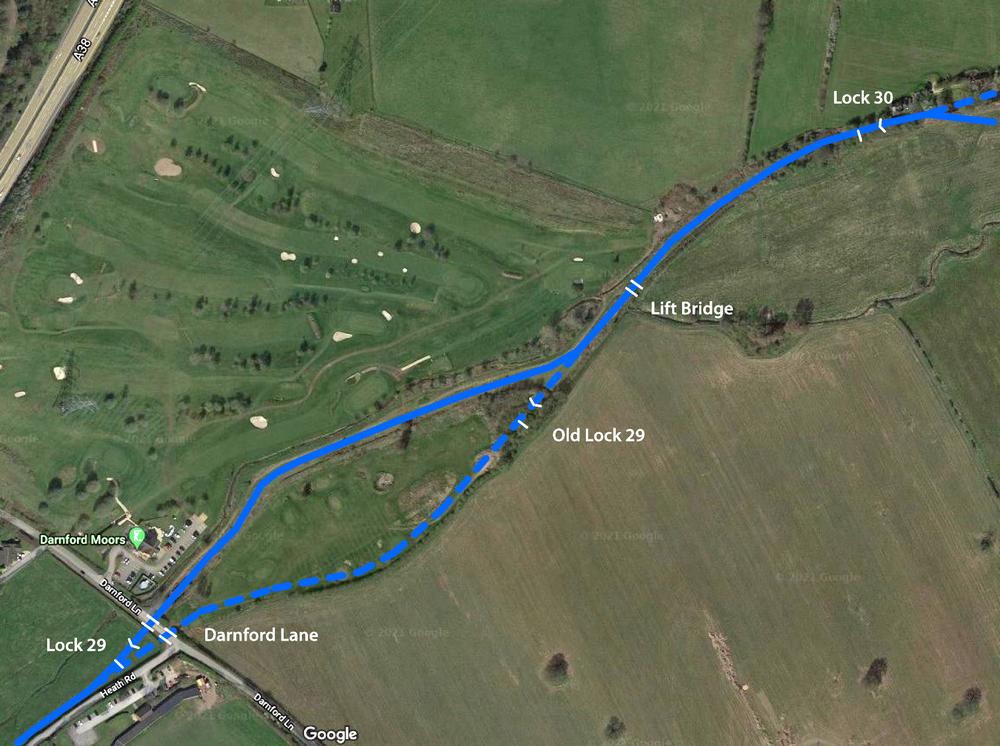
Beyond Watery Lane Bridge stands the rebuilt Cappers Bridge. Sadly this structure will never see the passage of a boat as this is where HS2 will cut across the canal. The Trust has successfully negotiated that HS2 will divert the canal in a gentle loop to the South of its current line. A third Capper’s Lane Bridge will be built before the new channel passes under the HS2 viaduct, re- joining the original line just below the bottom lock, lock 30. This work will be carried out by HS2 in the next couple of years.
The Trust have purchased the line of the canal from here onwards, including Lock
30, but agreement will need to be reached with neighbouring land owners before
this section can be reopened. It may be necessary to resite Lock 30 slightly
above its current location towards the new lift bridge.
2. Darnford
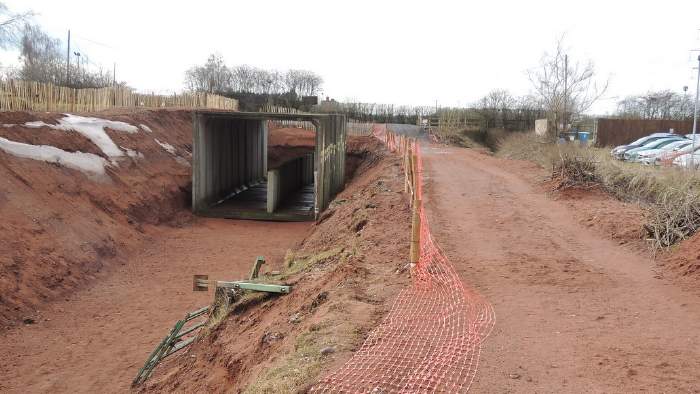

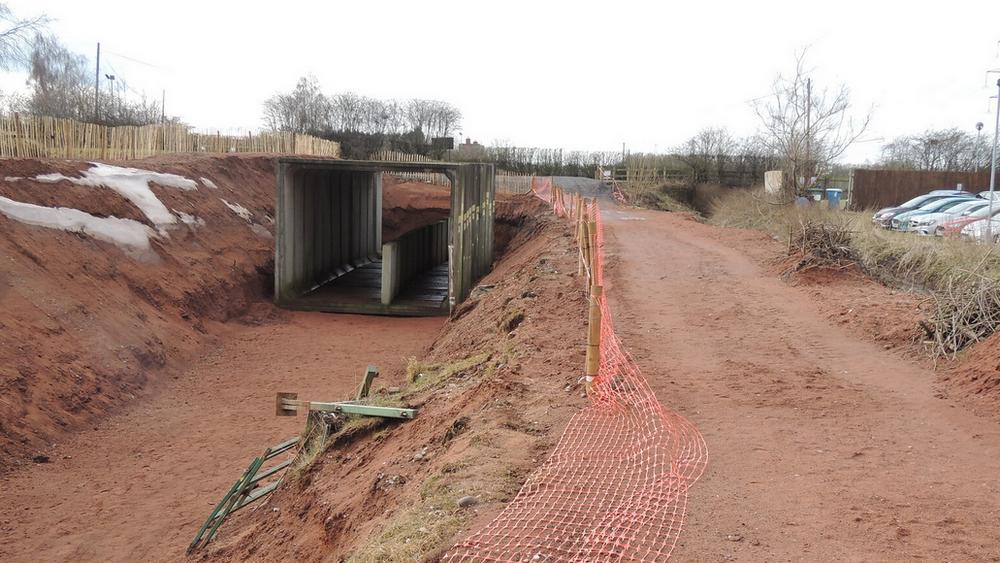
The next section has seen considerable work from the Trust in the past, including the reinstatement of the Darnford Brook culvert, installation of the new lift bridge, and excavation of a new channel from just below old Lock 29 to Darnford Lane. Further work will be required on this length to adjust the levels and profile of the new channel, with further work to strengthen the piling.
The old bridge at Darnford Lane sat right on the junction with Heath Lane. The new bridge will be located slightly to the NW of the old bridge and at a lower level since the old lock 29 will not be used. The concrete sections from which the new culvert will be formed are already on site waiting to be installed under the roadway..
Beyond the road crossing will be a new lock 29 which will return the canal to its original
level and allow it to re-join its original course for about 100m alongside Heath
Lane. Further challenges on this length are that Darnford Brook is environmentally
sensitive and there is a very narrow corridor for the new crossing, channel and
associated earthworks.
3. Freeford
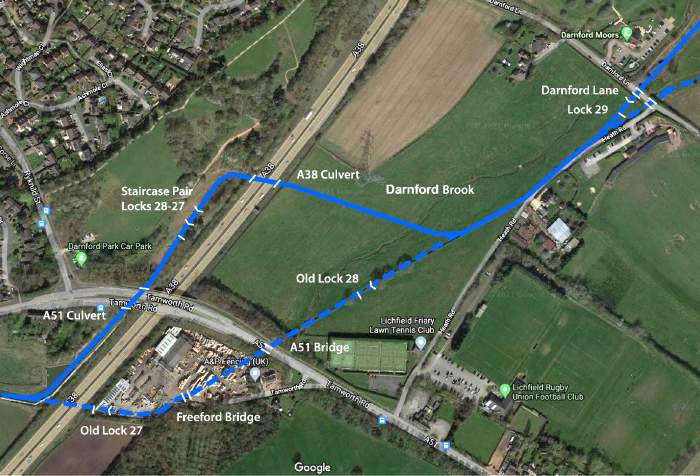
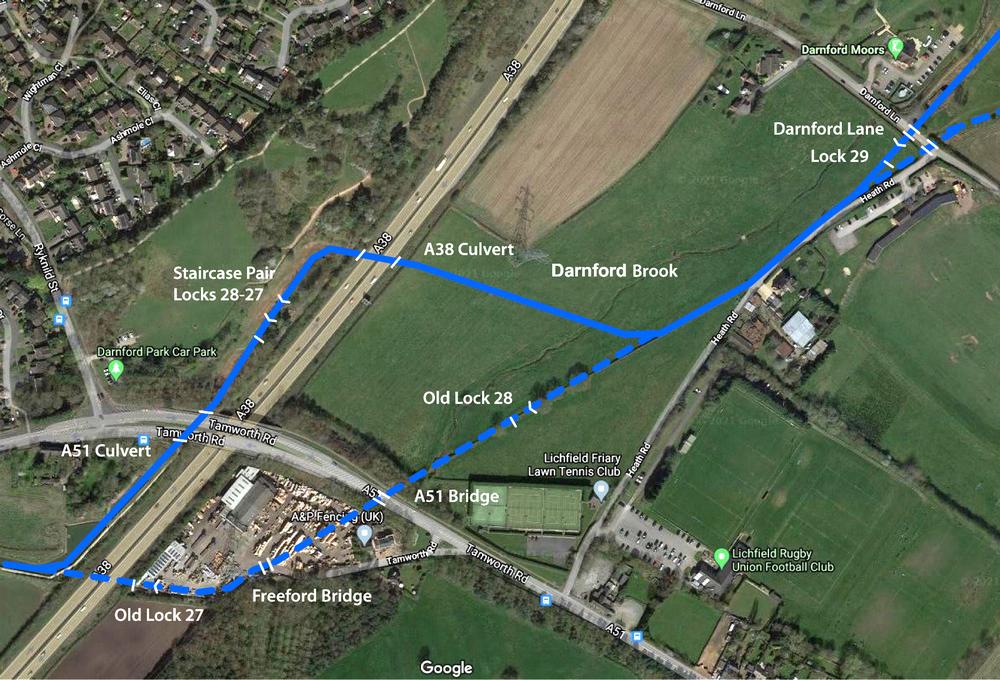
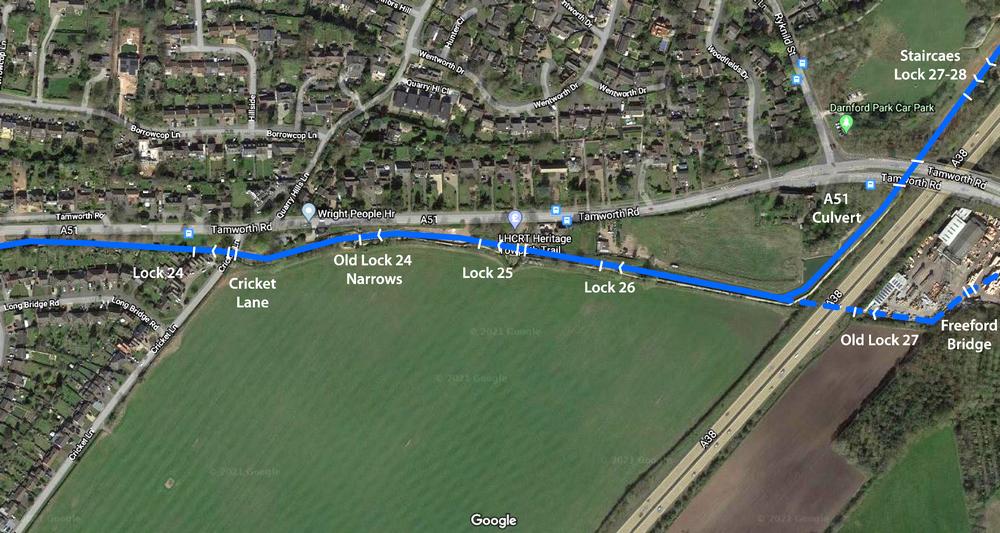
Beyond that heathland, the canal will again leave its original course and turn to the West just before old lock 28. This new route will bypass the two former bridges at Freeford, old locks 28 and 27 and the A38 crossing. The new alignment will have to cross Darnford Brook, either with a syphon or the brook flowing through the canal. This will require negotiation with the environment agency and present the opportunity for creation of new wetlands. Once again, the Trust will need to identify a solution which is also acceptable to local land owners.
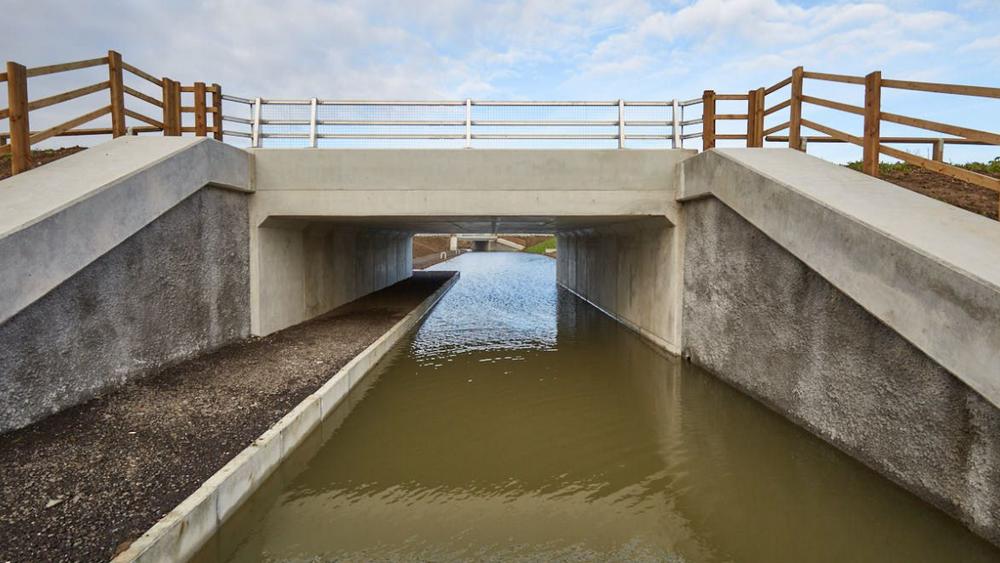
The canal will then pass under the A38 in a new box culvert. Whilst this is a major financial challenge for the Trust, it should be remembered that the Cotswold Canal Trust has very recently overcome a similar obstacle to restoration on the A38 many miles to the south. The culvert needs to be aligned to ensure there isn’t too sharp a turn as the canal emerges on the North side of the road.
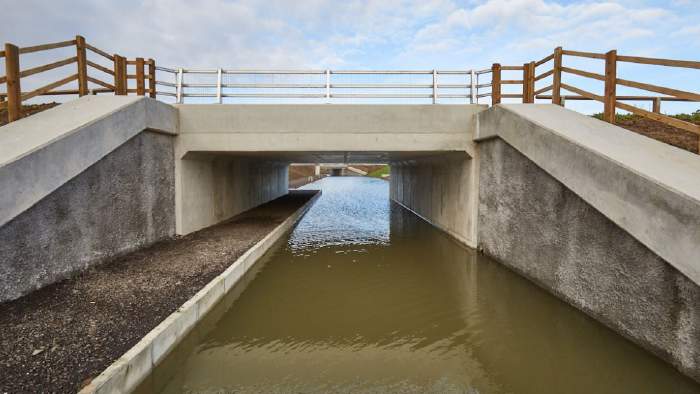
The new line will then rise through a staircase pair of locks before a new box
culvert under the A51. These locks may employ a back pump to reduce water consumption. Some excavation has already been
carried out by the Trust in this area. The A38 marks a transition for the canal
from open farmland to the rapidly expanding outskirts of the city of Lichfield.
4. Borrowcop
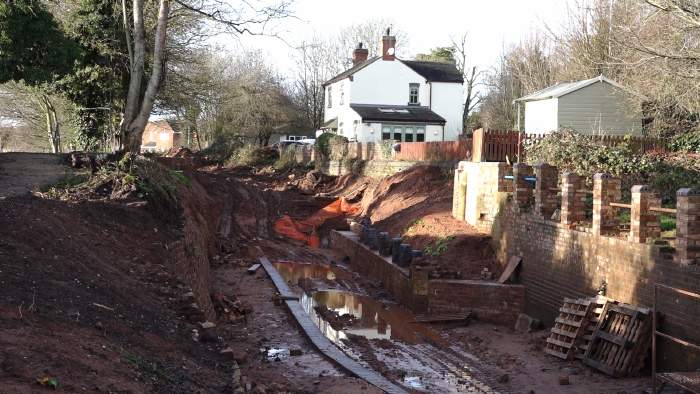
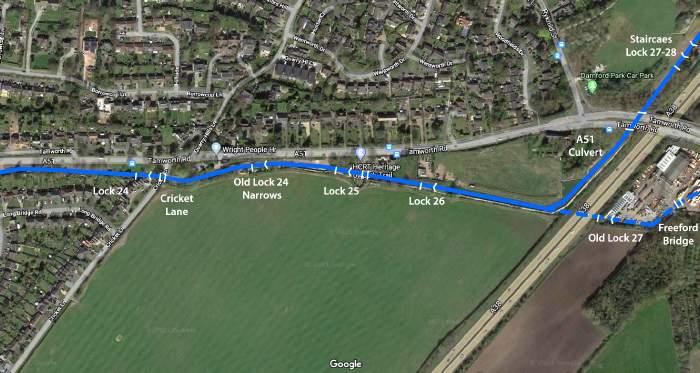
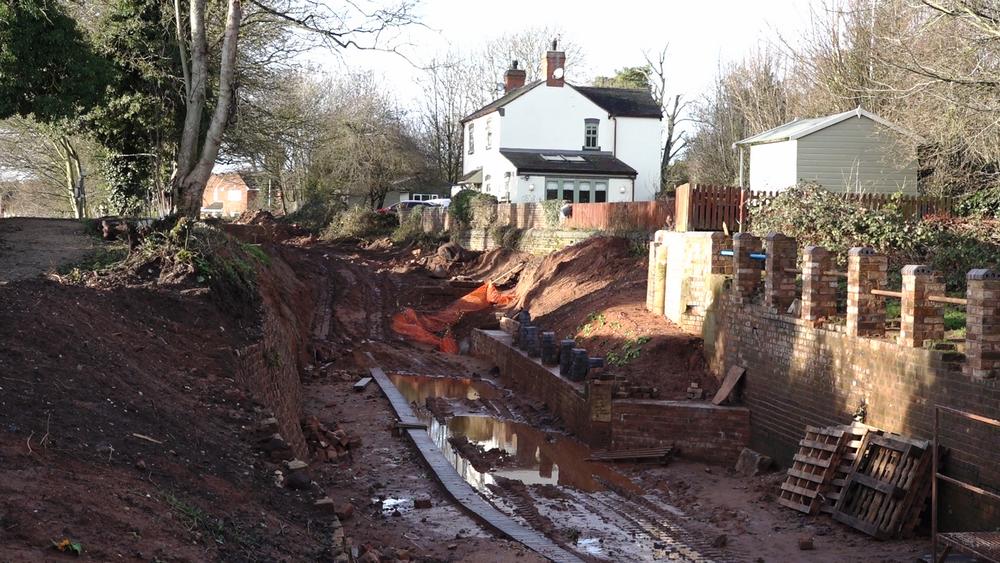
To the south of the A51 the line comes to the restored section at Borrowcop including Locks 26-25. All that’s required here are new gates for the locks. However the top lock of this flight, old Lock 24, cannot be restored. This is because Cricket Lane used to cross the canal on a hump backed bridge a short distance above the lock. It’s not possible to reinstate the bridge at its former level and so Lock 24 will have to be relocated to the other side of Cricket Lane so the canal can pass under the road.
This will require the lowering of the channel between old Lock 24 and Cricket Lane. This, in turn, is complicated because the original alignment of the lock would mean the channel beyond would undermine the bank and lock cottage above. Old Lock 24 will survive as a narrows, widened at the upper end to allow boats to turn into the new lower channel above. New buttresses are currently being built using reclaimed material from the lock to support the walls, bank and cottage lock.
The channel beyond Cricket Lane is currently being dug out to its new, lower level. The new culvert under Cricket Lane will be built by Persimmon Homes as part of a new development nearby in the next couple of years. The Trust will then need to build a new Lock 24 beyond the crossing to bring the canal back to its original level, avoiding the electricity substation and the services in the area.
5. St. Johns
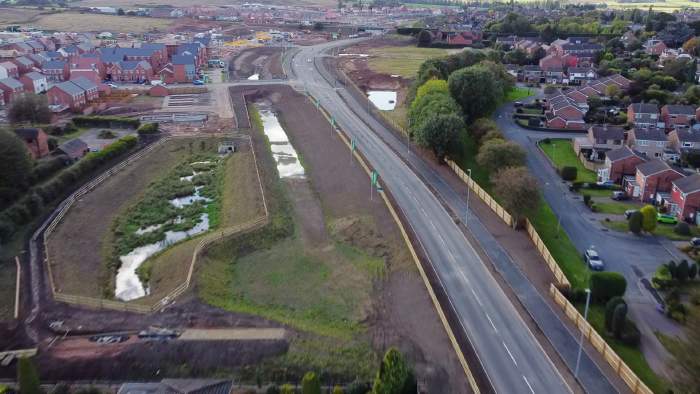
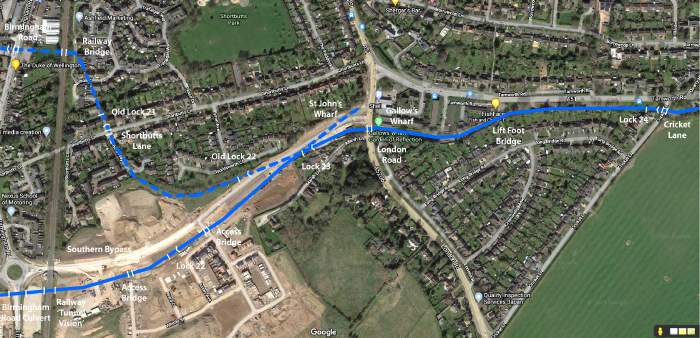
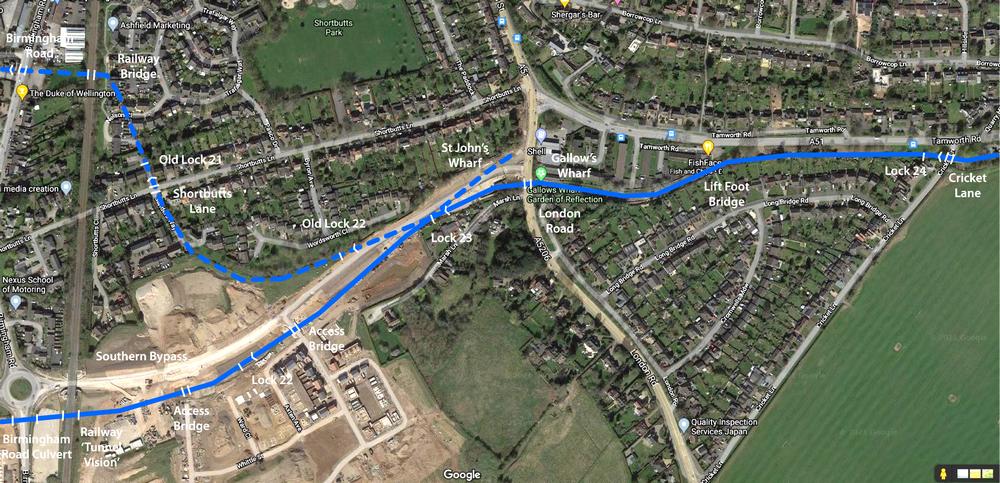
The canal now runs through residential housing. Above the new lock 24 the old channel needs to be dug out to join up with the recently completed section running up to Gallows Wharf. It’s hoped this work will start very soon. This section contains the only footpath to cross the Lichfield canal and the Trust have built bases for a new lift bridge which will become a feature on this length.
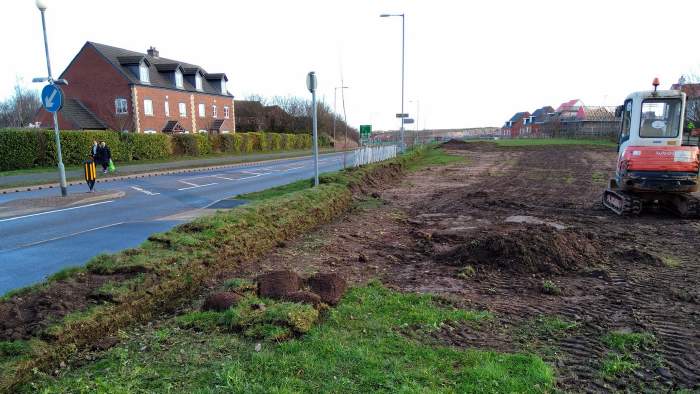
After passing under the surviving London Road Bridge the channel will be re- excavated as far as lock 23. All the land from here up to the railway is currently being made over to the Trust from Persimmon homes. Lock 23 will be used in the restoration, but due to the new Lichfield Southern Bypass there would not be room for boats to exit the top of the lock on its current alignment. The solution is to build a bend into the top of the lock to allow boats to leave at a different angle and continue into the new pound above.
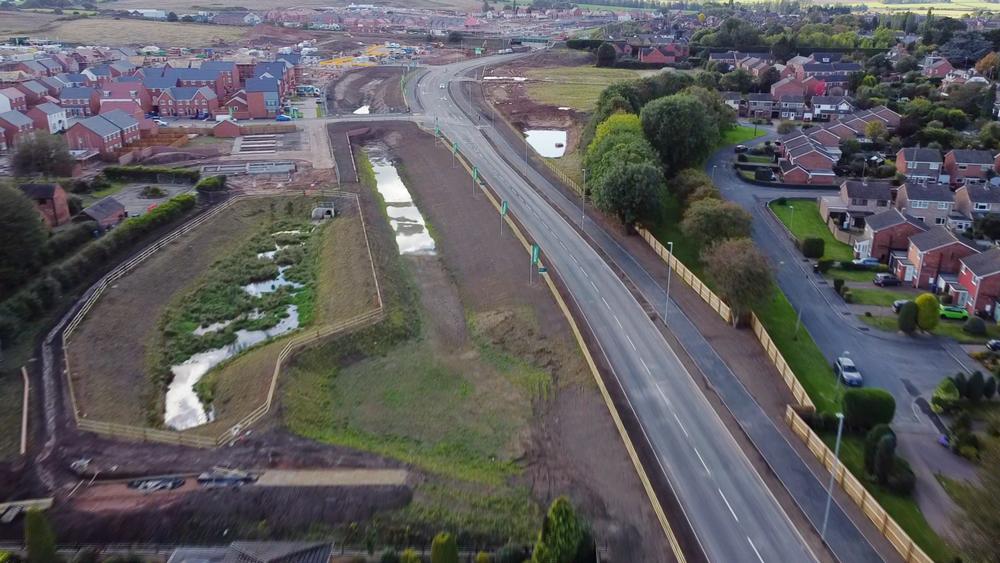
From here to Old Lock 19 the canal will follow a completely new line as there has been considerable construction on the original route, including old Locks 22 to 19, rendering it unrestorable. The first section of this new route up to the railway has been roughly dug out and two new access bridges to the new housing estate built by Persimmon homes. This section will require final profiling, lining and the building of a new lock 22.
A further challenge will be draining the rather boggy land to enable the works to be carried out. We are grateful to Persimmons homes who have greatly helped the restoration of the canal here.
6. Sandfields
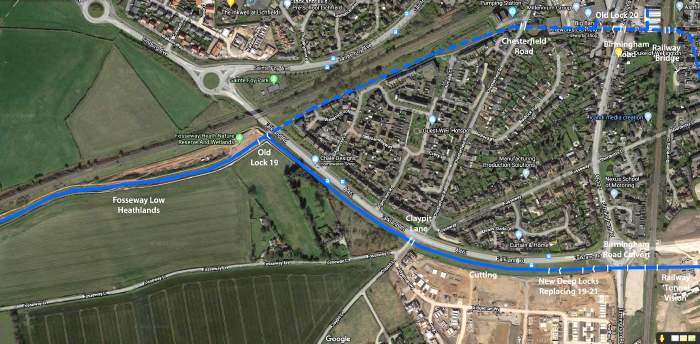
This brings us up to the railway. It was hoped that a tunnel under the railway could be installed at the same time as the bypass was built with massive cost savings, but in the event this was not possible so a new tunnel under the railway will have to be provided. The ongoing Sir David Suchet appeal, Tunnel Vision, can be found elsewhere on this site. Immediately beyond the railway, a culvert has already been installed under Birmingham Road and its roundabout with the bypass. This has temporarily been buried but will ultimately connect to the new tunnel under the railway.
Beyond the tunnels two new deeper locks will replace old Locks 21, 20 and 19. The canal will then enter a deep cutting which will require excavation into the underlying sandstone. A culvert will need to be built under Claypit Lane and further cutting through the land that falls gently to the new length of canal built alongside Falkland Road.
This will then connect up to the length restored from Falkland Road just above old Lock 19. The restored channel moves beyond the outskirts of Lichfield and passes through the Fosseway low heathland and restored Lock 18 (Wood Lock) to arrive at Fosseway Lane. This length has seen many environmental improvements with hedge planting and a wetland trail. It will require lining before rewatering and gates for the restored Lock 18.
This completes our short survey of the restoration of the lower half of the Lichfield canal from Huddlesford Junction to Fosseway Lane, the section that has seen the vast majority of restoration work carried out to date, and which will see considerable activity over the next few years.
Duncan Moore

Become a member of the Trust and support us from wherever you live, from the comfort of your home: